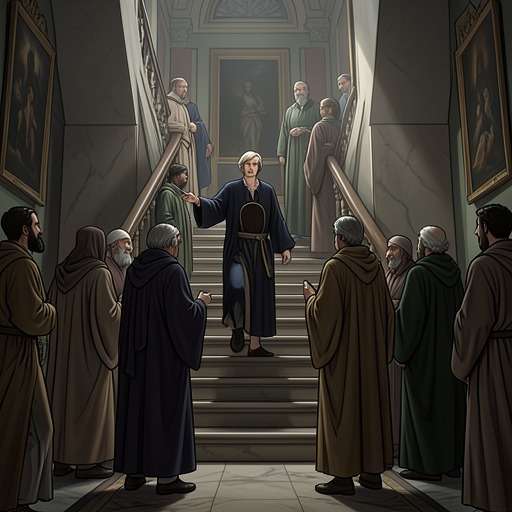
Decay and Restoration (Kû)
I ChingDecay and Restoration (Kû) presents disorder not as a condition to endure but as accumulated damage that must be understood and repaired. Its central promise—great progress and success—is conditional on dealing properly with decay: the work demands effort comparable to crossing a great stream and attention both to what brought the crisis about and to what must follow its turning point. The hexagram’s line texts carry that restoration from difficult family obligations toward the possibility of stepping outside public affairs altogether.
The Hexagram’s Argument
The judgment associates Decay and Restoration (Kû) with great progress and success, but does not make recovery automatic. It couples that prospect with the image of crossing a great stream, a measure of the effort required, and counsels weighing events three days before and three days after the change. The paired time spans make reform a matter of both diagnosis and follow-through: an intervention should address how deterioration arose and what measures will secure the result.
The commentary explains the name through the hexagram’s place after Following: those who follow another are bound to undertake services, and Decay and Restoration follows. Here the service is painful or troublesome because things have gone to ruin, figured as though through poison or venomous worms. The auspice of progress depends on arresting that decay and restoring soundness and vigor. The image therefore gives repair a demanding, active shape: improvement is possible, but only through substantial effort and careful consideration of causes and remedies.
Family Duty and Restraint
The first line casts the work of repair as a son’s response to troubles caused by his father. If the son is capable, the father can escape blame for having erred. The position is perilous, yet the line promises good fortune in the end. Restoration here is neither a denial of inherited trouble nor a simple transfer of blame: the son’s ability to deal with it changes the eventual outcome.
The second line turns to troubles caused by the mother. It warns the son not to carry firm correctness to its utmost. The contrast with the first line makes restraint part of the repair itself: a principled response is not necessarily improved by being pushed to its extreme. The commentary acknowledges that its assignment of mother and son to these lines is difficult to account for, and reports a traditional explanation that the family roles are accommodated to the wording rather than intended as a hidden mystery. The roles are therefore presented as the language through which the line’s counsel is expressed, not as a fully explained structural rule.
Position, Authority, and Withdrawal
The commentary reads the fifth line as the ruler’s seat, though the line itself is weak; its proper correlate is the strong second line, figured as a capable minister or champion to whom the hexagram’s work is delegated. The image connects restoration with a division of responsibility: authority rests in one position, while effective action is entrusted to a strong counterpart. This relation complements the family lines, where the task likewise falls to someone responding to troubles initiated by another.
At the other end of the sequence, the sixth line depicts one who serves neither king nor feudal lord and instead attends to his own affairs in a lofty spirit. The commentary links that image to the line’s strength and its lack of a proper correlate below: the subject stands outside the sphere of public action and turns to self-cultivation. The hexagram thus closes not with another public remedy but with withdrawal, setting the labor of restoring a damaged order against the possibility of leaving public service behind.
Interpretation and Translation
The account of the hexagram illustrates a broader method of reading the I Ching. The whole-hexagram judgment and the line texts have different functions: King Wen interprets each figure as a whole and may indicate an appropriate action and its likely fortune, while the Duke of Zhou proceeds from the bottom line upward, explaining each line through a symbolic image and a related indication of fortune. The overall interpretation is presented as harmonious with the combined meanings of the six lines, even though the line imagery can require difficult interpretive work.
That difficulty is also a problem of translation. The translator recounts that an attempt in 1854 to follow the original’s concision produced English with too little syntactical connection, much like an earlier Latin version. His later principle is not literal substitution: Chinese characters are treated as symbols of ideas, and translation as an effort to enter the author’s thought and express its meaning as accurately and concisely as possible. He says that occasional added words indicate what the original thought supplies implicitly, and that such additions are generally placed in parentheses. For Decay and Restoration (Kû), this approach matters because its short, emblematic counsel—family trouble, the arduous crossing, measured timing, and eventual withdrawal—must be made intelligible without pretending that every symbolic relation is self-explanatory.